About
I am a PhD Candidate in Applied Mathematics in my final year at Northwestern University, where I am also a member of the Center for Interdisciplinary Exploration and Research in Astrophysics (CIERA). I study numerical methods in scientific computing and their application to problems in geophysics and astrophysics. I was supported by a NSF Graduate Research Fellowship from 2023 to 2026. I am advised by Daniel Lecoanet, and some of my collaborators include Keaton Burns, Chris Vogl, and Anna Frishman. Prior to my graduate studies I worked with Carolyn Ernst, Muruhan Rathinam, and Jinglai Shen.
Research at a glance
Circumpolar vortex dynamics in differentially rotating forced-dissipative turbulence

Many planets in our solar system are home to interesting atmospheric dynamics, from Saturn's high-altitude hexagonal flow patterns thought to be signatures of Rossby waves, to large-scale jets and vortices (e.g., most famously, Jupiter's Gread Red Spot). In a more recent discovery, the NASA Juno mission observed clusters of vortices at Jupiter's North and South poles (e.g., as described by Adriani et al. (2018)). Since then, models of polar vortex formation have seen renewed interest. It is generally thought that planetary rotation plays a crucial role in stabilizing and confining these formations to the polar regions, but there are many questions left to unravel. In particular, I am studying simulations of polar vortex formation in differentially rotating forced-dissipative 2D turbulence to better understand how Rossby waves may drive circumpolar vortex dynamics.
Stability analysis of IMEX timestepping schemes
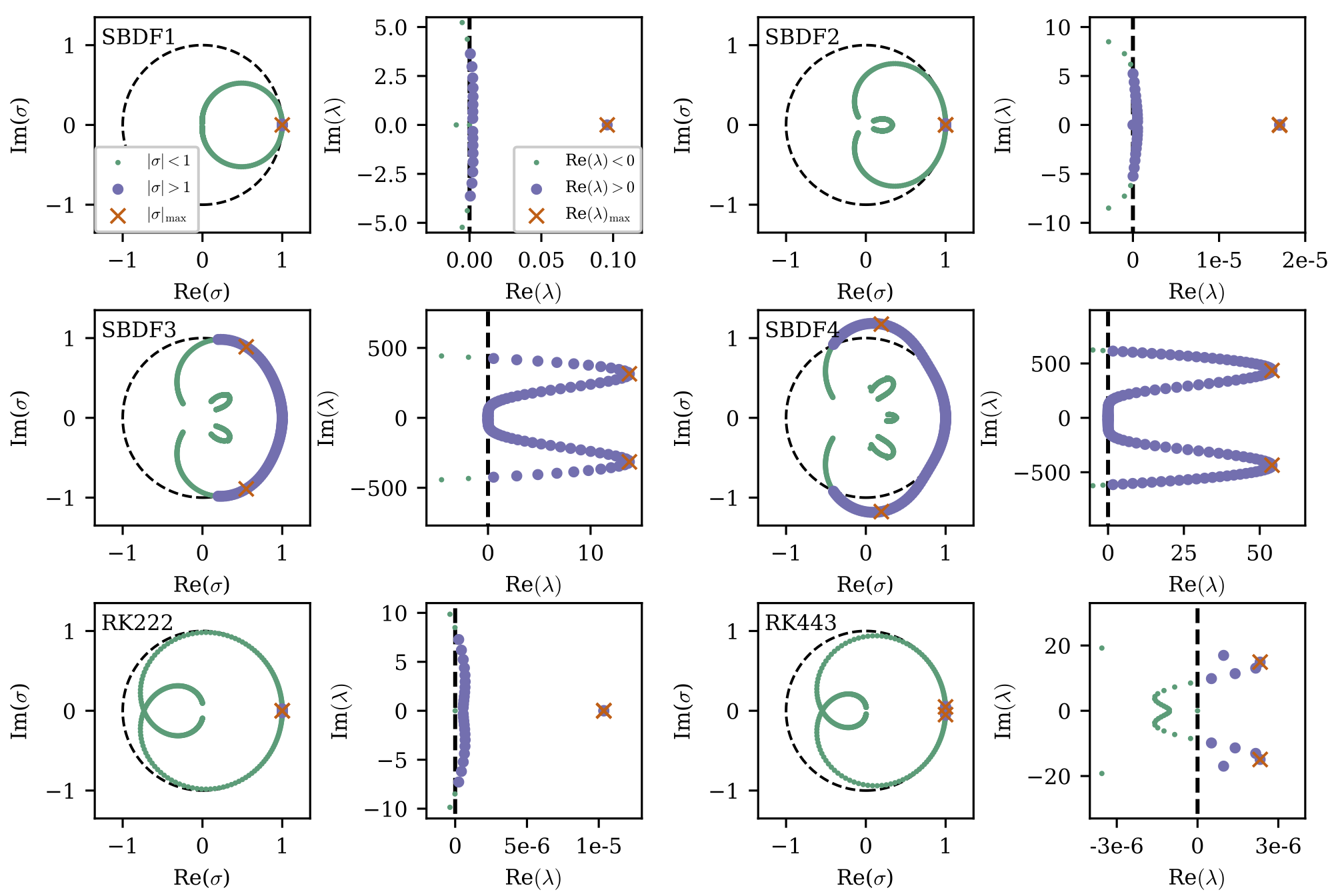
I use the pseudospectral code Dedalus primarily to evolve fluid dynamics simulations forward in time. Dedalus is designed to use multistep and multistage implicit-explicit (IMEX) schemes for time-stepping, and the time step size is typically selected by satisfying a CFL stability condition on the explicit terms. The stability properties of these schemes are well understood in the context of linear theory, but there remain open questions when evolving nonlinear flows. I have used methods from multiscale asymptotics to develop an analytical framework to determine the stability of IMEX schemes when solving for the propagation of nonlinear waves. A peer-reviewed manuscript on this work is published in the Journal of Computational Physics here, and can otherwise be found on the arxiv here. My analysis has so far been successfully applied to dispersive problems (e.g., soliton propagation), but future work can look to extend this analysis to problems with dissipation and to other classes of timestepping schemes.
Analysis of operator splittings for timestepping geophysical systems
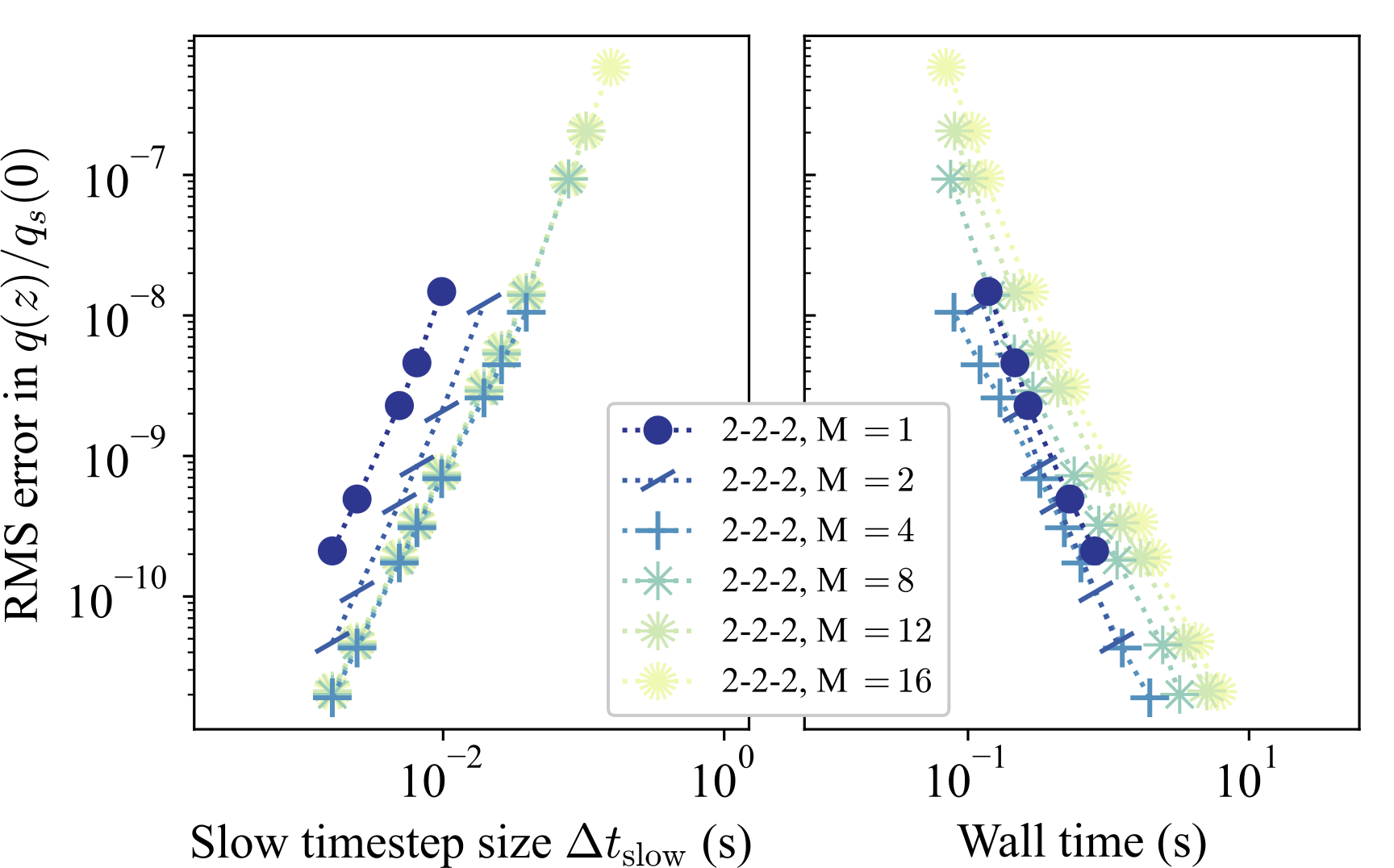
In 2024 I had the opportunity to work in the Center for Applied Scientific Computing at Lawrence Livermore National Laboratory. I investigated temporal operator splitting methods, such as those used to couple the different physical processes included in the E3SM Atmosphere Model. I presented results from this work at AGU24; an abstract can be found here. I am currently interested in comparing the performance of different types of operator splittings (multirate, IMEX, etc.) and their suitability for timestepping geophysical systems (e.g., moist convection, aerosol models, etc.) when there are large separations in time scales.
Convective boundary mixing in massive stars
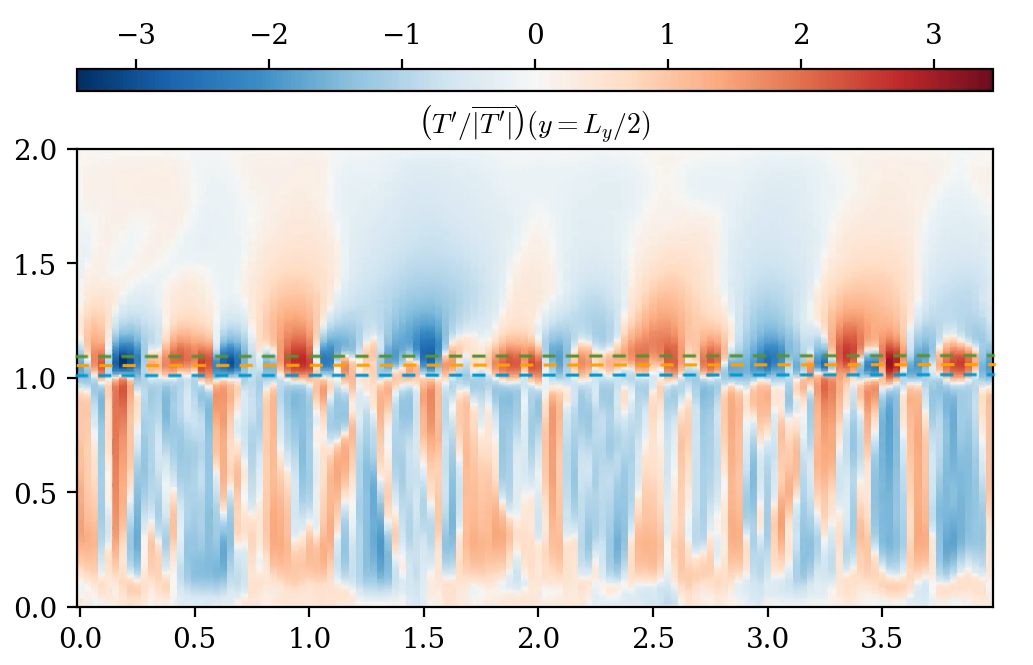
Models of stellar evolution rely on developing parameterizations to approximate theoretical predictions from first principles, e.g., by extrapolating the results of nonlinear direct numerical simulations. Previous studies (e.g., Anders et al. (2022)) have used 3D hydrodynamical simulations to study convective penetration, which is a source of uncertainty in current stellar evolution models. I have ran 3D simulations to quantify how rotation alters the efficiency of mixing at the radiative-convectiv boundary and determine whether the extent of the penetration zone is affected.
Selected publications
- B. A. Hyatt, D. Lecoanet, E. H. Anders, K. J. Burns, "Multiple scales analysis of a nonlinear timestepping instability in simulations of solitons", Journal of Computational Physics, vol. 531, p. 113923, 15 Jun 2025. (doi)
- E. H. Anders, D. Lecoanet, M. Cantiello, K. J. Burns, B. A. Hyatt, E. Kaufman, R. H. D. Townsend, B. P. Brown, G. M. Vasil, J. S. Oishi, A. S. Jermyn, "The photometric variability of massive stars due to gravity waves excited by core convection", Nature Astronomy, vol. 7, pp. 1228-1234, 27 Jul 2023. (doi)
For a full list, see my CV here.